Two days ago I climbed the Direct South Ridge of Notchtop with longtime climbing partner Sam. We started early, leaving my house at three in the morning, leaving the trailhead at four, breathing heavily on the approach under a cooling blanket of stars and navigating by headlamp until the alpenglow began. The crystal-bell song of a hermit thrush announced the arriving morning, and we reached a clearing and could see our objective in the day’s new light.
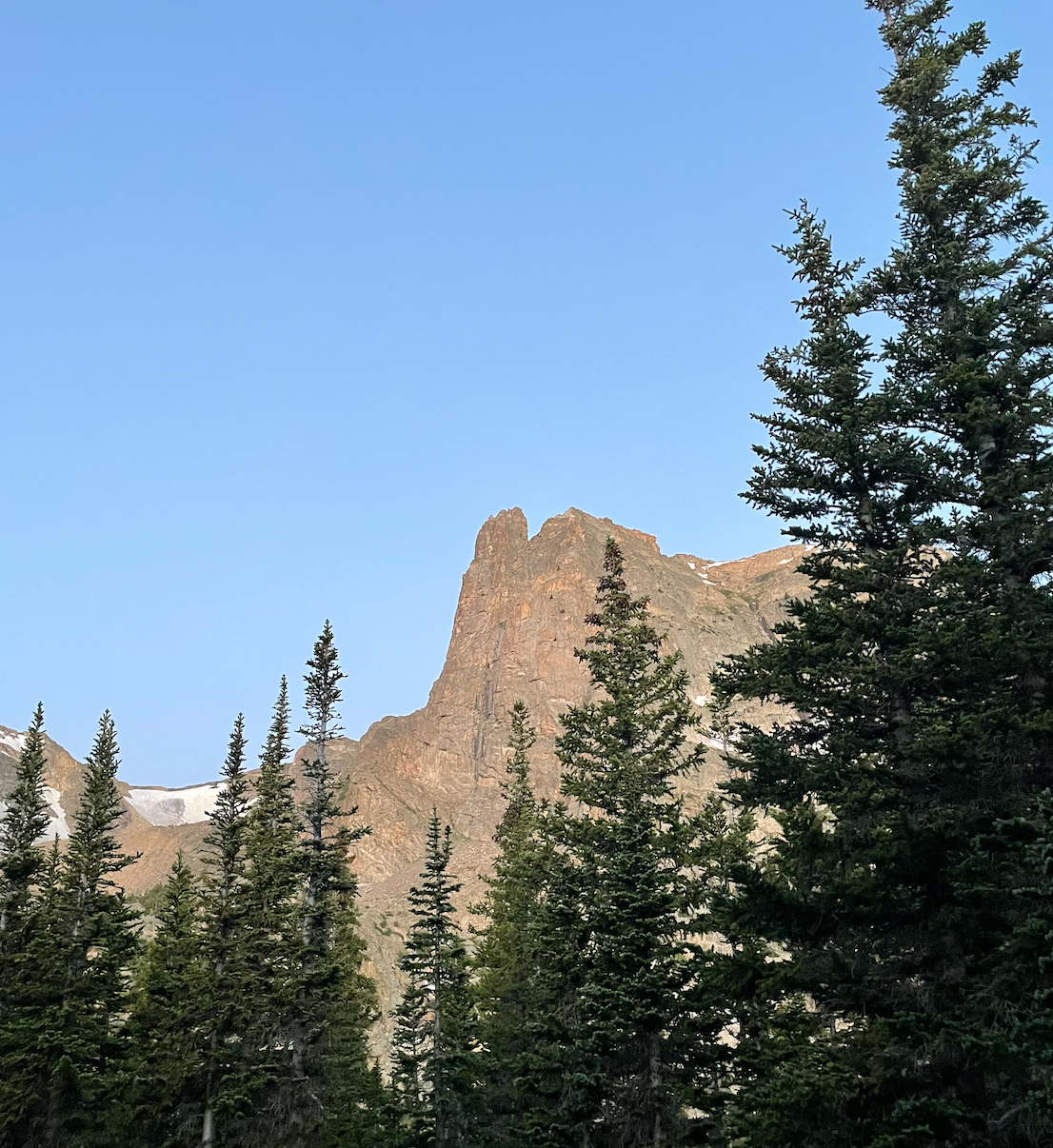
Climbing can be nice like that sometimes: wishing and wanting to climb the tallest wall in the area means that you can often see it for miles. Stoke builds. Motivation clarifies. There are not many goals in life these days that are so clear, yet on this glorious, brightening day, all we sought was to reach the bottom and then to climb as high as we could and then return home safely. These are much easier tasks to specify than the goals of modern life: to climb one’s career or social ladder is much more complicated than to climb a pile of rocks. The sharp ridge, our goal, knifing through the sky to a prominent tower left of the namesake notch, drew our gaze and held it as we continued walking, buoyed by the clarity of mind and the fresh, clean mountain air.
We escaped the main path after three miles and picked our way along the edge of Lake Helene, a beautiful, shallow accumulation of snowmelt surrounded by wildflowers. The brilliant red sun rose above the horizon just as we started to hike through the krummholz above the lake, picking our way through gnarled trees stunted by season after season of heavy snow and freezing wind.
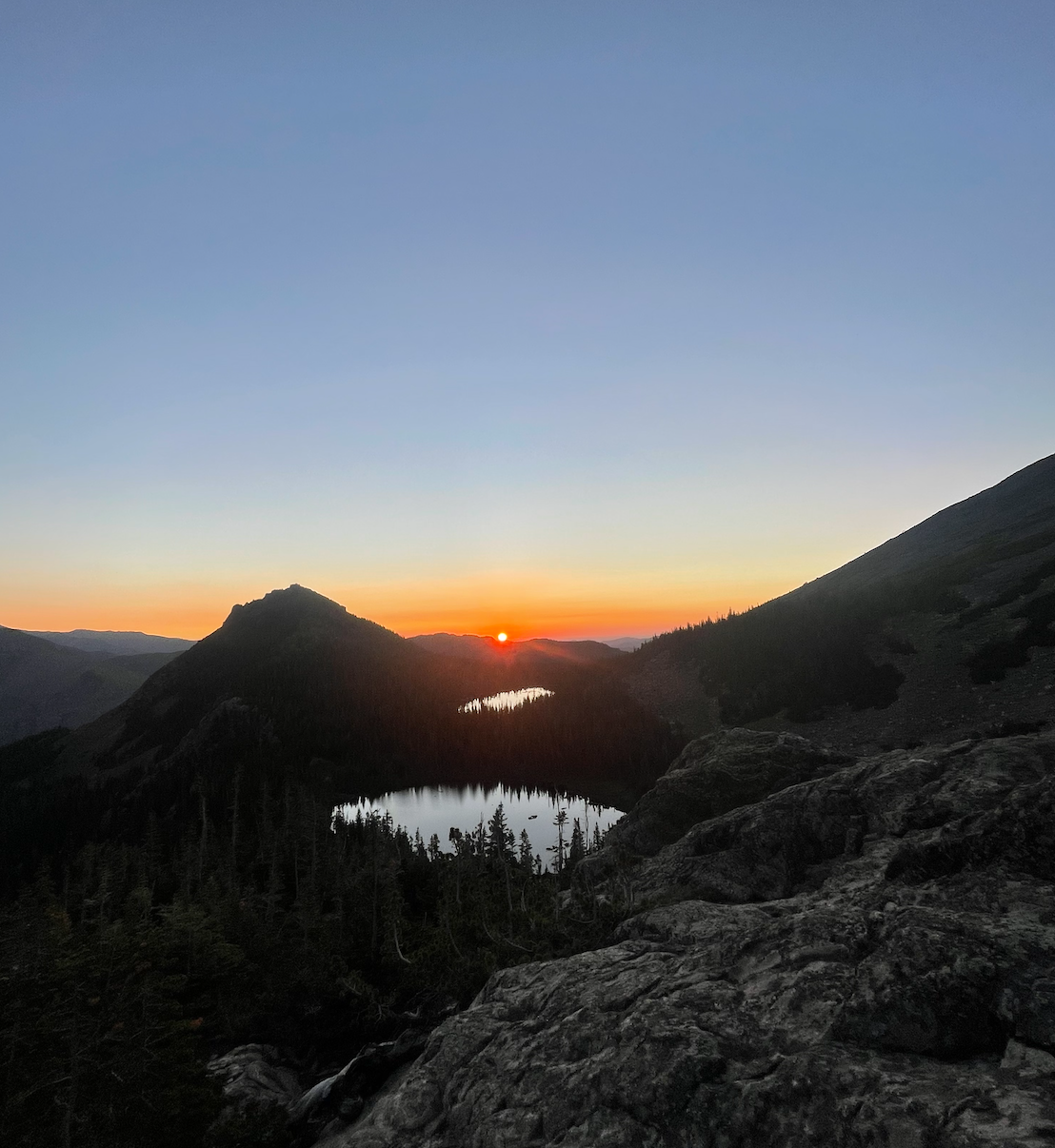
Erratics made for good footing and pathfinding. Before long we crossed Fern Creek, which spills infinitely from the perpetual snowfields that blanket the cirque above Odessa Gorge, and trudged up the steepening scree field to the base of the Notchtop massif. As we approached the wall stretched ever taller. The butterflies in my stomach fluttered and flew, just as the painted lady and orangetip butterflies spiraled through the flowers beside us. The route is a technical one: by the Rossiter guidebook, seven pitches of climbing between 5.5 and 5.9 in difficulty. It promised to stay right on the ridge and chase the most direct way to the summit above the notch. We planned to solo the approach pitches, which largely followed a low fifth class ramp before depositing us at the toe of the ridge, and we did so, each of us carrying one of our two twin ropes on our backs and jangling a fine tune with our gear as we crept to the start.
The climbing was better than advertised. We ended up summitting in three long pitches, full 60m rope lengths: Sam combined the guidebook p1-2, I combined the guidebook p3-5, and then Sam took us to the top with guidebook p6-7. I’m not entirely sure how that happened, since the guidebook described each pitch as being much longer than it was in real life, and it seemed impossible to link the way that we did, but our way went easily and smoothly and tackled all the crux pitches as described. This is another joy of climbing: reading about a route and translating it into real, physical body motion. You read of a crack pitch with difficult roof moves and then experience the effort and the position and the strength and the pushing and pulling required to put yourself safely through those written moves. You read of a wandering traverse to find a chimney and experience the uncertainty and delicacy and balance required to find the same safe passage. You read of belay ledges and find them, stunning in their true earthly position, simply indescribable in the way you can suddenly sit and relax while hundreds of feet above anything at all, surrounded by singing rosy-finches and massive amounts of air.
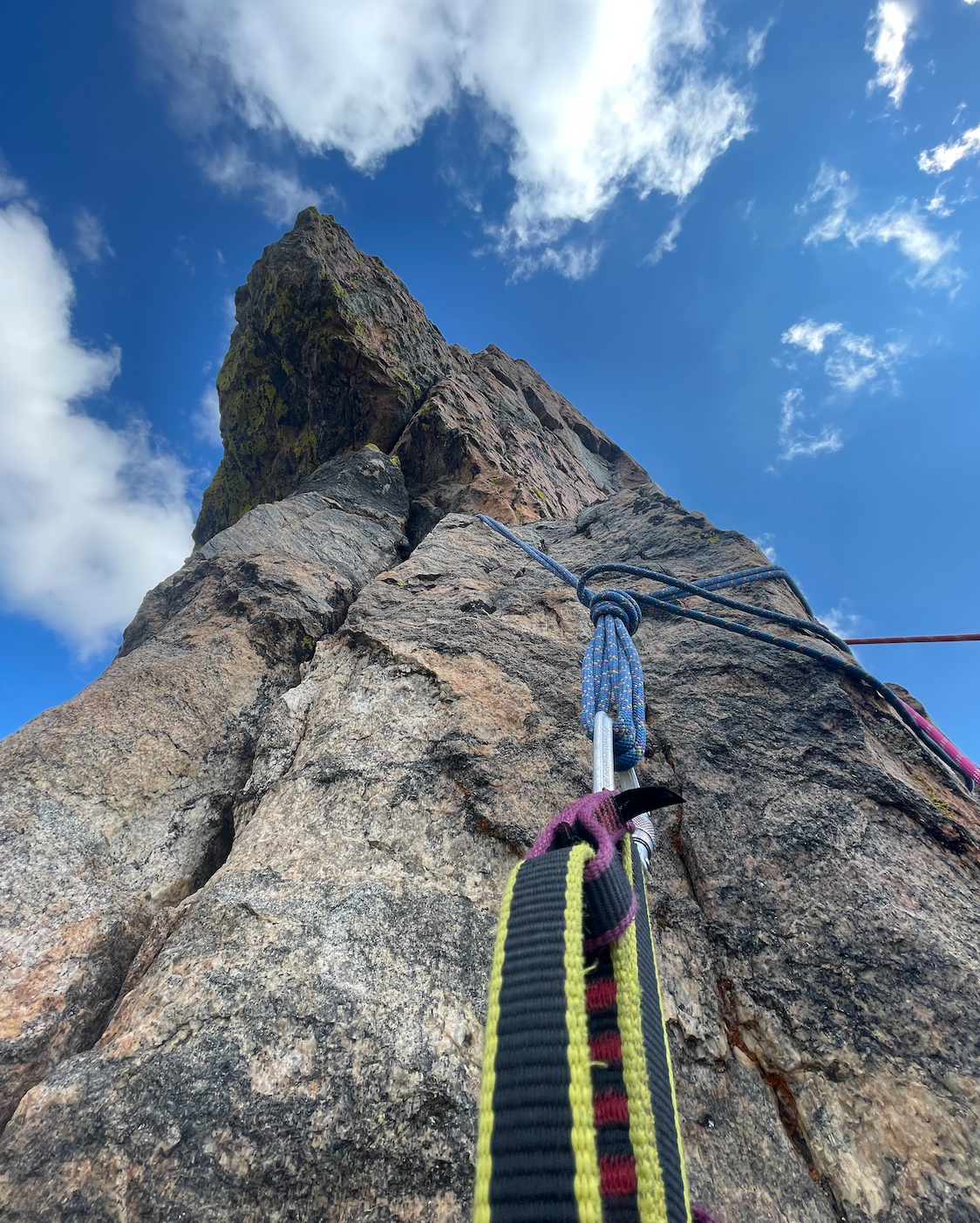
Nothing was too difficult: the cool crux cracks forced sustained exertion, but we both found excellent stemming with our feet, pressing out in almost a full split above hundreds upon hundreds of feet of exposure as we cranked jams to pull ourselves through the moves. The rest of the movement featured delightful face climbing on abundant edges and knobs, the type of climbing that I think we all dream about, just hard enough to stay interesting while easy enough to feel comfortable. A flowing of movement, limbs and mind in concert with the whispering wind. Something interesting happens to me when I progress skyward in this manner. It is as if I have left an exoskeleton myself on the ground and I am freshly unburdened by the thoughts and worries I was carrying. I climb to fully be present within my body and on my planet, and the weights of my worrying conscious remain on the ground below. I climb to see the same world from a higher perspective, to understand how things look from a pair of eyes that see from far beyond where my eyes normally can. I climb to feel the height of it, to grip and pull on a piece of stone with nothing between me and falling to my death except the attention of my belaying friend and the very force of my tendons and muscles.
Summitting happened almost too quickly. We were enjoying the journey up the ridge and then the ridge ended and we touched the sky and had to return. On the way down we spoke at length about the protections that were being lifted from Bear’s Ears, a place Sam has climbed and that I have visited, a magical place full of sacred land and wild earth, just like the mountain we climbed. We talked about why it is that some places get protected and others get threatened, the nefarious nature of wielding power to targeting sacred land and erase indigeneity, the cancerous parts of humanity that seek to destroy and consume and burn the beautiful things in the world. It was a difficult conversation. I cried on the hike, covered as I was in cold river water to stay cool, just thinking about bulldozers breaking down the sandstone. From on top of the world, on top of Notchtop, I looked for miles in all directions and saw nature. There was water and snow and ice and life in concert with the rocks. It was the kind of place that should be protected, and we as a species should know this, do know this, do realize that we are best when we are in harmony with our animalistic selves and living in the real world of rock and sun and wind and water. Bear’s Ears is that kind of place too, and the removal of its protections is an ominous portent of the direction our species seeks to take: away from the natural and towards the artificial, towards the digital and the data-hungry and the destructive. With my newfound perspective I could see it all clearly laid before me, the path our species was taking, one of exhausting and fully-draining dry the wellspring of life from our planet before spreading like a virus to new planets. But what if we all burn up beforehand in the fever of the Earth?