om - fireflies
Tell someone in Boulder that there are fireflies twenty minutes from their house and they will tell you, kindly, that you are mistaken. Fireflies are an Ohio thing, a Tennessee thing, something you remember from a grandmother's porch somewhere east of the Mississippi and then grow out of. Colorado is too dry, too high, too thin. But go out to a wet meadow in the last two weeks of June, after the sun is properly gone and the grass has begun to cool, and stand still for a while: first one, then another, then a slow green rain of them coming up out of the sedges, and the whole field turns out to have been full of light the entire time, waiting for anyone to come and look.
Almost nobody has come to look. The Photuris that flash over the ditches of Boulder and Fort Collins have no settled scientific name. They've been called Photuris coloradensis, a name proposed by Tristan Kubik of the Colorado Natural Heritage Program and used, for now, in the absence of anything official. However, recent DNA sequencing and phylogenetic tree reconstruction work I have led with Luke Tembrock of Colorado State suggests the Front Range Photuris may in fact be an introduced or non-native Photuris lucicrescens species. These compete with Pyractomena dispersa, an orange swamp ember found across the Western United States, for habitat and larval forage, and may even predate their adults. In addition to these, we found Photinus obscurellus up in a subalpine meadow in Divide, at over nine thousand feet, which had never been described in Colorado and had never been recorded that high anywhere. Down in the Four Corners someone turned up Microphotus pecosensis. The Butterfly Pavilion raised Fort Collins Photuris from larva to adult for the first time only last year, so that even the basic life history of the thing is younger than most of my field notes. This is not a well-thumbed corner of entomology that I am adding a footnote to. There are beetles flashing in irrigation ditches within sight of Denver that science has not gotten around to naming. There are lights in the high mountains that are biological in origin.
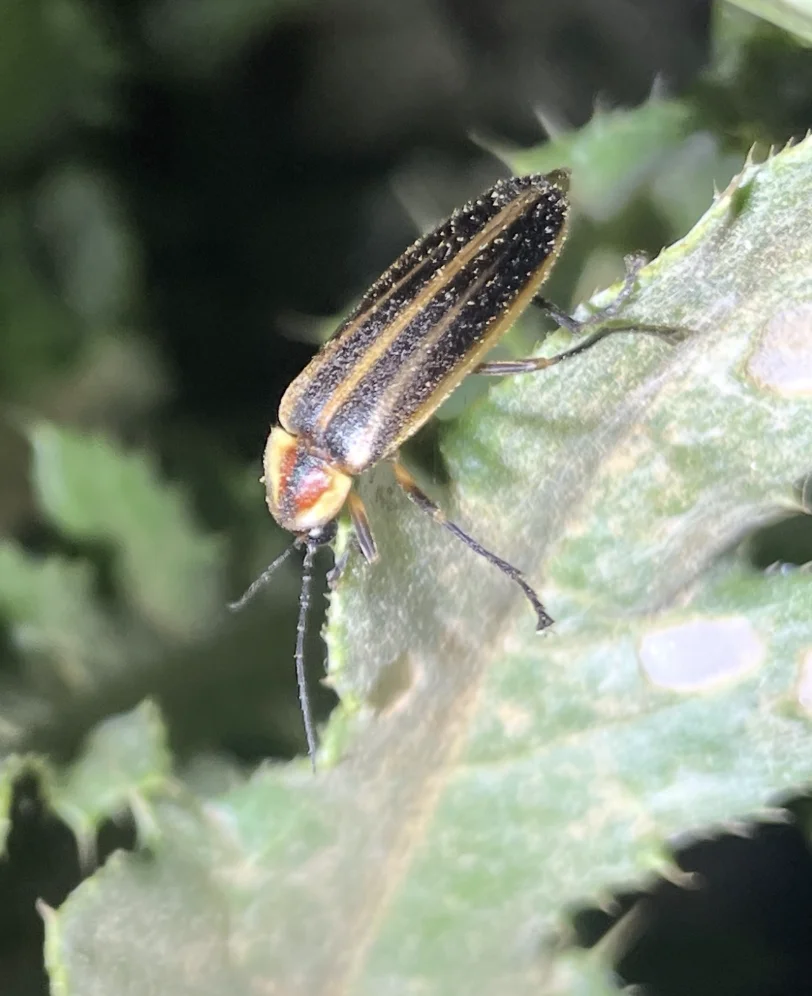
Photuris male, covered in thistle pollen after a day of hanging out in the flowers, waiting for the emergence of his female conspecifics. Boulder, Colorado.
So for three seasons I have been trying to write them down. The method is relatively affordable, because it has to be repeatable by volunteers in a dark field: two 360-degree GoPros, set in stereo, left running all night. Afterward the footage is reconstructed into the position and moment of every individual flash, (x, y, z, t), and those flashes are chained into streaks and the streaks into trajectories, until what was a wall of blinking becomes a list of who was where and what they said while they were there. Out of that come inter-flash intervals and flash lengths and the number of pulses in a phrase — the grammar of a species, written in the only language it has. Beside the cameras we net a few individuals, photograph the pattern on the abdomen under a macro lens, keep tissue for barcoding, and let them go, so that the behavior and the body and the genome all end up describing the same animal.
It only works because of the people. In 2023 there were two of us and a lot of guessing about when to show up. By 2024 and 2025 there were more than twenty trained volunteers running cameras at Sawhill Ponds, Little Dry Creek, Riverbend Ponds, Divide, and Firefly Meadow in Loveland, and several terabytes of flash patterns where there had been only stories.
All of it is in service of conservation, primarily of the land where these fireflies live. The habitat is wet and narrow and drying up, the adults are on the wing for maybe two weeks at a given site, and a population can be erased by ordinary good intentions: a field mowed on the wrong week, a ditch drained on the wrong week, a parking lot lit all night beside a meadow that needs the dark to hold a conversation. Knowing the phenology is what lets me tell a landowner or a county open space manager which two weeks matter, and the genetic and morphological work is what will let an entomologist finally give these animals names. A firefly without a name is very difficult to protect, and the ones out here have waited long enough.
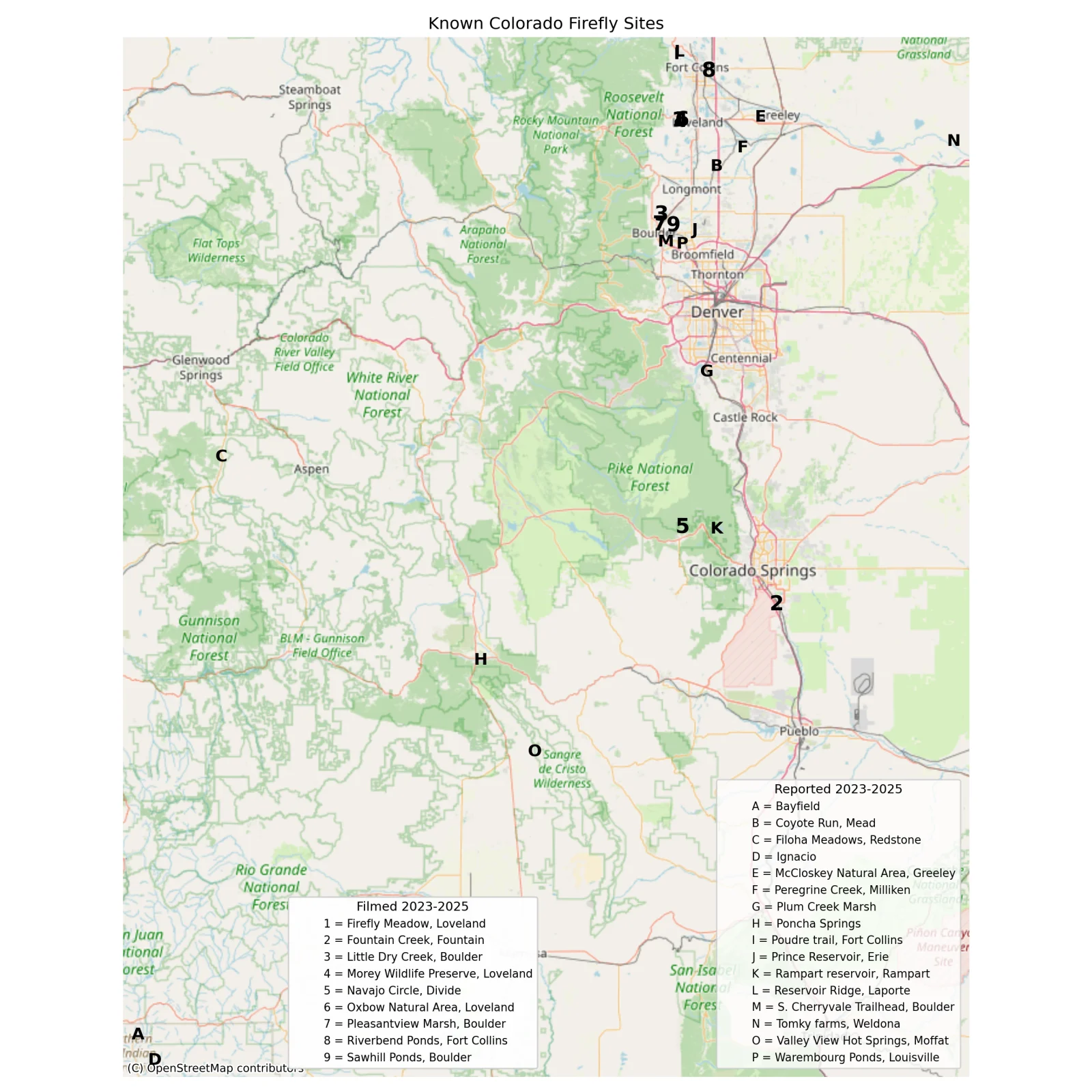
Map of survey and film locations in Colorado from the past three years. Numbered pins represent locations from which we have flash pattern footage, while the letter pins represent locations from which we have anecdotal reports, Firefly Atlas surveys, or personal observations without recordings.
— Figure 25, On Synchronous and Distinguishable Flash Behavior Across the Lampyridae Family (2025).
If you think you have fireflies near you, I would love to hear about it — let me know here. More on this work in The Conversation, Colorado Public Radio, and CU Boulder Today.